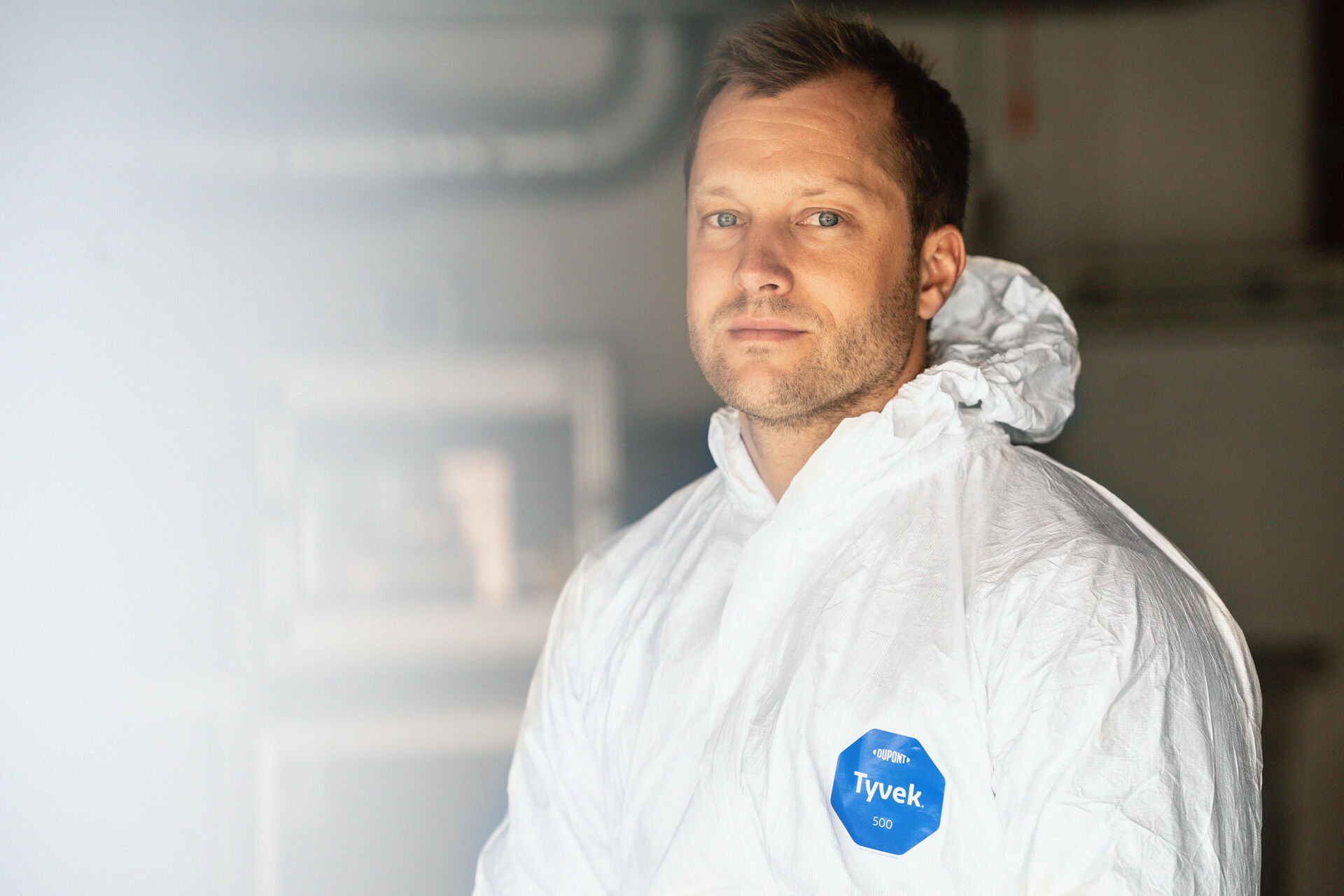
Kripos' forensic technicians work on a wide range of tasks. They assist with crime scene investigations, weapon seizures, autopsies, and more. In Norway, Kripos is the national competence center for the Norwegian police, and the national forensic laboratory is located here.
"I love my job, and I look forward to going to work every single day. I think a lot of it comes from knowing that my job is important. Both for the investigation of the cases we are working on, but also because there are people who want answers about what has happened. For some, it may not mean much in the grand scheme of things, but for others, it is actually the small details that make a big difference."
Forensic science is the investigation of crime scenes, traces, and trace materials to clarify the sequence of events of a criminal act, fire, or accident, to shed light on the motive or cause, and to identify the perpetrator or victim.
The Silent Witnesses
The main task of the forensic technician is to search for, collect, secure, and document evidence that can provide insights into a sequence of events. It is an important job that helps to illuminate whether something criminal has happened and whether someone can be punished for it. Much of what we do can also help prevent new incidents.
"The forensic technician's task is to be able to say something about what has happened based on - often called the silent witnesses, or the traces, that can be secured at a crime scene. We conduct investigations at places where we suspect something criminal has happened, but also at accident sites. We examine living people and deceased people, but also objects that may have been used or are connected to a criminal act," explains Mats.
.jpg)
The forensic technician is often the closest to the crime scene and spends a lot of time at places where something has happened. In this way, they possess a lot of information that can further contribute to the investigation.
Mats explains that a typical workday is often event-driven, and they spend a lot of time working on ongoing cases.
"We have ongoing cases that we work on and examine materials that have been seized, clothes from victims or suspects. We have relatively clear ideas about what we are going to do when we go to work every day. But the days are also event-driven. You can come to work, and an incident has occurred that makes us prioritize differently and have to go out to crime scenes," says Mats, adding:
"It is often the small pieces and details that I contribute that can help solve the whole big picture. That motivates me."
Solved His First Case During His Internship
Before Mats started at Politihøgskolen, he had completed the prison officer training and worked for a few years in the correctional service.
"I enjoyed it very much there, but there were more opportunities in the police, and I decided that now was the time to try. I jumped in and started at the Police Academy and do not regret it today. The fact that no two days are the same, that you can have some days that are hectic, some days that are calm, and some days where you are at the center of things. It is very motivating."
The best part of the study was the mix of theory and practice, he recalls.
"The first year we get a lot of theoretical knowledge, and we get to practice something practical. During B2, or the internship year, we have greater opportunities to test out the theoretical part we learned in the first year. In the final year, we have the opportunity to go back and delve into things we want to become even better at," he says, adding:
"We meet people from all over the country, of different ages and with different backgrounds. The friends I made then are still friends I have today."
.jpg)
During his internship, he had a mentor with a special interest in forensic techniques.
"We were out at some burglary scenes and several car thefts where we managed to secure evidence that helped solve the cases. My mentor facilitated and motivated me to secure evidence. It created enthusiasm and was a lot of fun. I experienced great satisfaction in getting hits, that is, results, from what I did. I decided quite early that I wanted to continue working with this, and I was very lucky to get a job as a forensic technician after a short summer internship."
The Path to Becoming a Forensic Technician
Politihøgskolen offers several continuing and further education courses in forensic techniques.
"In terms of competence, anyone who has attended Politihøgskolen can secure evidence at a crime scene. Working as a forensic technician is essentially a job that anyone in the police can do. Those who patrol do it to a large extent. They secure evidence in everyday cases they attend to."
There are several local training programs around the police districts, and there is an opportunity to take studies and courses to increase competence when working in the police, explains Mats.
"I have been very fortunate and have acquired good general competence. In addition, I have gained specialist competence in interpreting bloodstains."
Do you have any tips for those who want to become forensic technicians?
"Already during Politihøgskolen, you can practice securing evidence. I think a lot of it is about daring to try and not being afraid to fail. Sometimes we may find that the evidence we secure is not good enough, but suddenly we get a hit, or a result, that we did not expect or hope for. It is incredibly motivating to actually be able to contribute with that," says Mats, adding:
"My tip is really to dare to try, dare to secure, and practice it. If you want to become a full-time forensic technician, you simply have to apply for a position as a forensic technician, but the patrols also secure an incredible amount of evidence. Everyone in the police has a little forensic technician in them," he concludes.